Introduction to Synthetic Biology
This course provides a comprehensive and beginner-friendly introduction to the principles of Synthetic Biology, focusing on the engineering of biological systems rather than biological discovery alone.
Students will explore key concepts such as genetic circuit design, standardization of biological parts, cell-free systems, genome engineering, metabolic engineering, and ethical considerations. Through interactive sessions, virtual hands-on exercises, and case studies, learners will apply synthetic biology concepts to real-world challenges in medicine, agriculture, and industry.
By the end of the course, participants will understand how biological systems can be designed, built, tested, and optimized using engineering principles.
Course Information
Duration: 3 Months (Weekly Sessions)
Start Date: 20 March 2026
Level: Beginner → Intermediate
Key Features
Clear introduction to synthetic biology as an engineering discipline
Focus on genetic circuits, biosensors, and biological system design
Virtual hands-on activities (PCR, cloning, circuit design)
Exposure to cell-free systems and minimal cells
Real-world case studies inspired by iGEM projects
Team-based final project with presentation and feedback
Ideal for students interested in research, industry, and innovation
Prerequisites
1️⃣ Biology Background (Required)
Basic understanding of:
DNA, genes, transcription, translation
Cells and basic molecular biology
No advanced genetics required
2️⃣ Basic Laboratory Awareness (Recommended)
Familiarity with common molecular biology concepts (PCR, plasmids)
No wet-lab experience required (virtual simulations used)
3️⃣ Computational Skills (Optional)
No programming required
Some bioinformatics tools will be introduced conceptually
4️⃣ Laptop Requirements
Operating System: Windows / macOS / Linux
Internet connection for virtual tools and resources
Course Outline
Session 1 — Introduction to Synthetic Biology & Engineering Principles (2 hours)
Topics Covered
Fundamentals of Synthetic Biology:
Abstraction
Decoupling
Standardization
Difference between Molecular Biology and Synthetic Biology
Design–Build–Test–Learn (DBTL) Cycle
Applications in medicine, agriculture, and industry
Learning Outcomes
Understand core principles of synthetic biology
Distinguish between biological discovery and biological design
Interactive Element
Group discussion: Discovery (Biology) vs Design (Engineering)
Session 2 — Biological Parts & Standardization (2 hours)
Topics Covered
Standard biological parts (BioBricks)
Registry of Standard Biological Parts
Genetic components:
Promoters
Ribosome Binding Sites (RBS)
Terminators
Plasmid databases
Learning Outcomes
Identify genetic parts and their functions
Understand the role of standardization in modular system design
Interactive Element
Case study: assembling a basic genetic circuit
Session 3 — Logic Gates & Genetic Circuit Design (2 hours)
Topics Covered
Boolean logic in biology:
AND, OR, NOT
Toggle switches
Oscillators and feedback loops
Biosensors: principles and applications
PCR and primer design for genetic assembly
Learning Outcomes
Understand logic-based control of gene expression
Design theoretical PCR strategies for circuit construction
Interactive Element
Virtual PCR exercise with restriction site design
Session 4 — Genetic Circuit Design & Genome Editing (2 hours)
Topics Covered
Cloning methods:
Gibson Assembly
Golden Gate
Restriction digestion
Base-editing cloning strategies
CRISPR-Cas9 and genome engineering
Learning Outcomes
Apply cloning strategies in synthetic design
Design primers for different assembly techniques
Interactive Element
Virtual cloning of a bacterial biosensor plasmid
Session 5 — Transformation, Chassis Organisms & Cell-Free Systems (2 hours)
Topics Covered
Types of transformation
Chassis selection:
E. coli
Yeast
Cell-free systems
Minimal genomes and artificial cells
Metabolic burden and host–circuit interactions
Types of cell-free systems
Learning Outcomes
Compare chassis organisms for synthetic applications
Evaluate how host choice affects circuit performance
Interactive Element
Group discussion: selecting chassis for industrial use
Session 6 — Ethics, Safety & Final Project Preparation (2 hours)
Topics Covered
Ethics and biosafety in synthetic biology
Analysis of iGEM projects
Designing a synthetic biology experiment
Theoretical biosensor-based detection models
Learning Outcomes
Design responsible synthetic biology solutions
Work collaboratively on real-world inspired projects
Interactive Element
Team-based modification of an iGEM project
Session 7 — Final Project Assessment & Presentations (3 hours)
Topics Covered
Student presentations (after 2 weeks of preparation)
Project defense and discussion
Peer and instructor feedback
Reflection on learning outcomes
Learning Outcomes
Communicate synthetic biology designs effectively
Critically evaluate scientific projects and improvements
Learning Outcomes
By the end of this course, participants will be able to:
Understand synthetic biology as an engineering discipline
Design basic genetic circuits and biosensors
Explain standardization and modularity in biological systems
Compare chassis organisms and cell-free systems
Apply DBTL principles to biological design problems
Evaluate ethical and safety considerations in synthetic biology
Present and defend a synthetic biology project
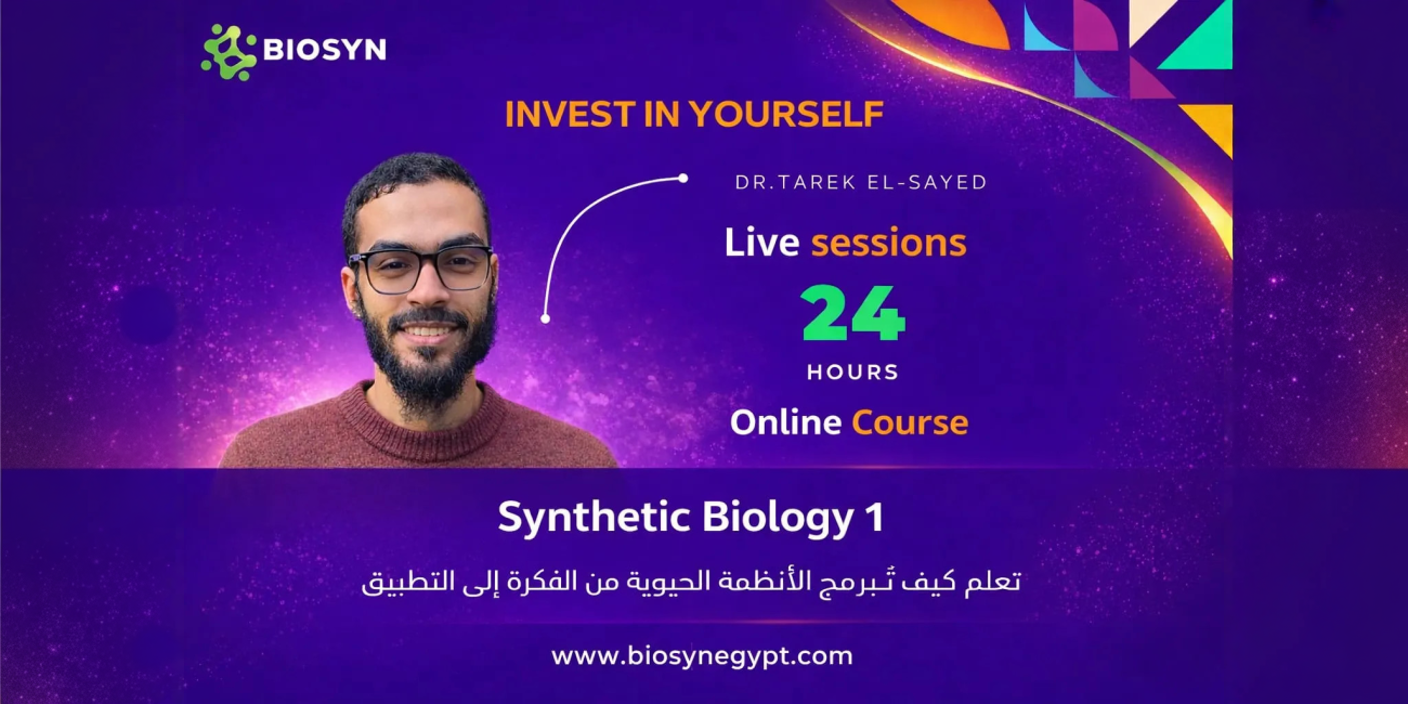
Instructor
Tarek Elsayed
Molecular and Synthetic Biologist
PhD Student, Münster University, Germany
BSc in Zoology & Chemistry – Fayoum University
MSc in Cancer Biology – University of PSL, Paris
Research at Gustave Roussy Cancer Institute
Focus on PARP proteins and DNA damage response
MSc in Systems & Synthetic Biology – Paris-Saclay University
Genome and protein engineering
Research interests:
Cell-free systems
Synthetic cells
Optogenetics
Genetic engineering
Co-founder of Octides (synthetic biology startup)
Judge in international competitions including iGEM
Scholarship recipient:
French Embassy in Egypt
Münster University, Germany
This course provides a comprehensive and beginner-friendly introduction to the principles of Synthetic Biology, focusing on the engineering of biological systems rather than biological discovery alone.
Students will explore key concepts such as genetic circuit design, standardization of biological parts, cell-free systems, genome engineering, metabolic engineering, and ethical considerations. Through interactive sessions, virtual hands-on exercises, and case studies, learners will apply synthetic biology concepts to real-world challenges in medicine, agriculture, and industry.
By the end of the course, participants will understand how biological systems can be designed, built, tested, and optimized using engineering principles.
Course Information
Duration: 3 Months (Weekly Sessions)
Start Date: 20 March 2026
Level: Beginner → Intermediate
Key Features
Clear introduction to synthetic biology as an engineering discipline
Focus on genetic circuits, biosensors, and biological system design
Virtual hands-on activities (PCR, cloning, circuit design)
Exposure to cell-free systems and minimal cells
Real-world case studies inspired by iGEM projects
Team-based final project with presentation and feedback
Ideal for students interested in research, industry, and innovation
Prerequisites
1️⃣ Biology Background (Required)
Basic understanding of:
DNA, genes, transcription, translation
Cells and basic molecular biology
No advanced genetics required
2️⃣ Basic Laboratory Awareness (Recommended)
Familiarity with common molecular biology concepts (PCR, plasmids)
No wet-lab experience required (virtual simulations used)
3️⃣ Computational Skills (Optional)
No programming required
Some bioinformatics tools will be introduced conceptually
4️⃣ Laptop Requirements
Operating System: Windows / macOS / Linux
Internet connection for virtual tools and resources
Course Outline
Session 1 — Introduction to Synthetic Biology & Engineering Principles (2 hours)
Topics Covered
Fundamentals of Synthetic Biology:
Abstraction
Decoupling
Standardization
Difference between Molecular Biology and Synthetic Biology
Design–Build–Test–Learn (DBTL) Cycle
Applications in medicine, agriculture, and industry
Learning Outcomes
Understand core principles of synthetic biology
Distinguish between biological discovery and biological design
Interactive Element
Group discussion: Discovery (Biology) vs Design (Engineering)
Session 2 — Biological Parts & Standardization (2 hours)
Topics Covered
Standard biological parts (BioBricks)
Registry of Standard Biological Parts
Genetic components:
Promoters
Ribosome Binding Sites (RBS)
Terminators
Plasmid databases
Learning Outcomes
Identify genetic parts and their functions
Understand the role of standardization in modular system design
Interactive Element
Case study: assembling a basic genetic circuit
Session 3 — Logic Gates & Genetic Circuit Design (2 hours)
Topics Covered
Boolean logic in biology:
AND, OR, NOT
Toggle switches
Oscillators and feedback loops
Biosensors: principles and applications
PCR and primer design for genetic assembly
Learning Outcomes
Understand logic-based control of gene expression
Design theoretical PCR strategies for circuit construction
Interactive Element
Virtual PCR exercise with restriction site design
Session 4 — Genetic Circuit Design & Genome Editing (2 hours)
Topics Covered
Cloning methods:
Gibson Assembly
Golden Gate
Restriction digestion
Base-editing cloning strategies
CRISPR-Cas9 and genome engineering
Learning Outcomes
Apply cloning strategies in synthetic design
Design primers for different assembly techniques
Interactive Element
Virtual cloning of a bacterial biosensor plasmid
Session 5 — Transformation, Chassis Organisms & Cell-Free Systems (2 hours)
Topics Covered
Types of transformation
Chassis selection:
E. coli
Yeast
Cell-free systems
Minimal genomes and artificial cells
Metabolic burden and host–circuit interactions
Types of cell-free systems
Learning Outcomes
Compare chassis organisms for synthetic applications
Evaluate how host choice affects circuit performance
Interactive Element
Group discussion: selecting chassis for industrial use
Session 6 — Ethics, Safety & Final Project Preparation (2 hours)
Topics Covered
Ethics and biosafety in synthetic biology
Analysis of iGEM projects
Designing a synthetic biology experiment
Theoretical biosensor-based detection models
Learning Outcomes
Design responsible synthetic biology solutions
Work collaboratively on real-world inspired projects
Interactive Element
Team-based modification of an iGEM project
Session 7 — Final Project Assessment & Presentations (3 hours)
Topics Covered
Student presentations (after 2 weeks of preparation)
Project defense and discussion
Peer and instructor feedback
Reflection on learning outcomes
Learning Outcomes
Communicate synthetic biology designs effectively
Critically evaluate scientific projects and improvements
Learning Outcomes
By the end of this course, participants will be able to:
Understand synthetic biology as an engineering discipline
Design basic genetic circuits and biosensors
Explain standardization and modularity in biological systems
Compare chassis organisms and cell-free systems
Apply DBTL principles to biological design problems
Evaluate ethical and safety considerations in synthetic biology
Present and defend a synthetic biology project
Instructor
Tarek Elsayed
Molecular and Synthetic Biologist
PhD Student, Münster University, Germany
BSc in Zoology & Chemistry – Fayoum University
MSc in Cancer Biology – University of PSL, Paris
Research at Gustave Roussy Cancer Institute
Focus on PARP proteins and DNA damage response
MSc in Systems & Synthetic Biology – Paris-Saclay University
Genome and protein engineering
Research interests:
Cell-free systems
Synthetic cells
Optogenetics
Genetic engineering
Co-founder of Octides (synthetic biology startup)
Judge in international competitions including iGEM
Scholarship recipient:
French Embassy in Egypt
Münster University, Germany