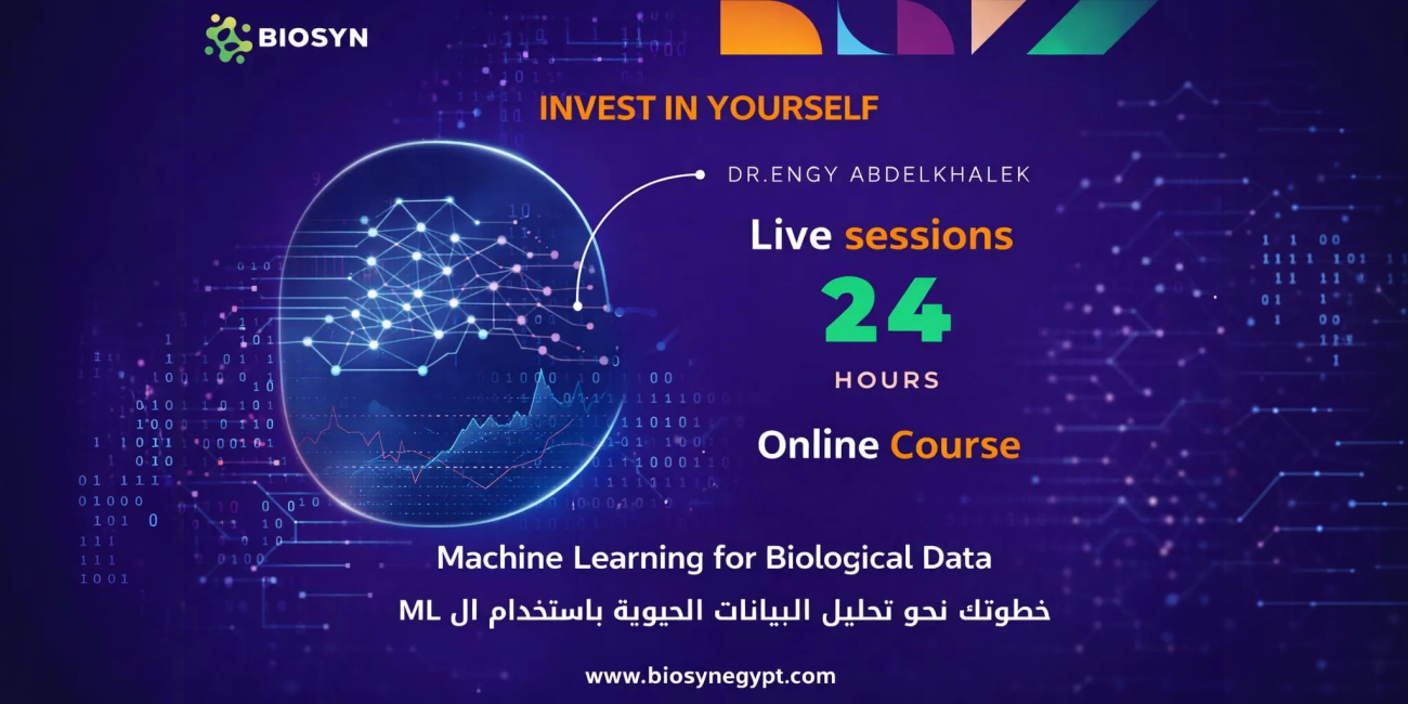
This course provides a practical and beginner-friendly introduction to how machine learning (ML) is transforming modern biology — from genomics and protein analysis to disease prediction and biomedical research.
Through a step-by-step curriculum, students will learn Python programming, explore real biological datasets, and build ML models to analyze genes, proteins, and cell-level data.
No prior programming or machine learning experience is required — the course takes you from the fundamentals all the way to building your first biological ML project.
By the end of the course, learners will be able to confidently manipulate biological data, apply ML techniques, and interpret computational results in a biological context.
Duration: 3 Months weekly session,
Start Date: 10, March, 2026
Key Features
Beginner-friendly—starts from Python basics.
Hands-on coding using real biological datasets (genes, proteins, gene expression).
Covers both supervised and unsupervised machine learning methods.
A strong mathematical foundation explained with biological examples.
Practical mini-project at the end to apply all techniques.
Suitable for biology students with no coding background.
Certificates upon completion (if applicable in your platform).
Prerequisites
This course is designed to be accessible for beginners in biology and data science. However, students are expected to have the following:
1️⃣ Basic Biology Knowledge (Required)
Understanding of fundamental biological concepts
(genes, DNA, proteins, cells, gene expression).
No advanced molecular biology required — basics are enough.
2️⃣ Basic Computer Skills (Required)
Ability to install software (Python, Jupyter Notebook).
Comfortable using a laptop and navigating folders.
3️⃣ Mathematics Foundation (Recommended)
Very basic understanding of:
Algebra
Simple statistics (mean, median, variance)
All advanced mathematical concepts will be taught in the course.
4️⃣ No Programming Experience Needed
The Python Crash Course inside the program will take learners from zero level.
All coding will be explained step-by-step.
5️⃣ Laptop Requirements
Operating system: Windows / macOS / Linux
Minimum 8GB RAM recommended
Internet connection to download datasets & libraries
Course Outlines:
Module 1 — Introduction to Machine Learning in Biology (2 hours)
What is machine learning?
How ML is used in genomics, protein analysis, and precision medicine
Installing Python, Jupyter, and required libraries
Module 2 — Crash Course in Python Programming (5 parts, 2 hours each)
Part 1:
Python basics
Variables, data types, lists, dictionaries
Loops, conditionals
Practical tasks: Reading FASTA files, GC content
Part 2–5:
Functions & modules
File handling
Working with biological sequences
Intro to NumPy & Pandas
Hands-on exercises with DNA & protein datasets
Module 3 — Biological Data & Exploratory Data Analysis (2 hours)
Types of biological data: gene expression, proteins, cells
Using Pandas to load and explore datasets
Data visualization: histograms, heatmaps, boxplots
Module 4—Data Cleaning for Biological Research (2 hours)
Missing values in gene/protein data
Data correction, normalization
Removing outliers, duplicates
Preparing datasets for ML models
Module 5—Mathematical Foundations for ML in Biology (3 hours)
Linear algebra for gene vectors
Probability for mutation frequencies
Statistics for disease rates
Biological examples integrated with math concepts
Module 6 — Supervised Machine Learning in Biology (3 hours)
Regression models for predicting biological measurements
Classification models for disease prediction
Model evaluation (accuracy, AUC, confusion matrix)
Module 7—Unsupervised Machine Learning in Biology (2 hours)
Clustering techniques for cell/gene data
K-means, hierarchical clustering
PCA for dimensionality reduction
Visualizing biological patterns
Module 8—Mini Project: Machine Learning Application in Biology (3 hours)
Choose a real dataset: gene expression, proteins, sequences
Clean, explore, and prepare data
Build ML models (supervised or unsupervised)
Interpret biological meaning behind results
Present a final report / notebook
Outcomes:
Apply machine learning techniques to biological datasets (genomics, proteins, disease prediction).
Write Python code for bioinformatics and DNA sequence analysis.
Clean and explore biological data using Pandas and visualization tools.
Build regression and classification models for solving biological problems.
Use clustering and PCA to analyze gene expression and cell-level datasets.
Understand mathematical foundations (linear algebra, probability, statistics) in biological contexts.
Complete a full end-to-end ML project using real biological data from preprocessing to modeling to interpretation.
Instructor:
Dr.Injy Abdelkhalik
- Informatics Master Student
4 years- skilled in various skills ( Metagenomics , Bash, R, Python , Machine learning)
Bsc in biotechnology, Faculty of Science - Cairo University